Grammar — Auxiliary verbs
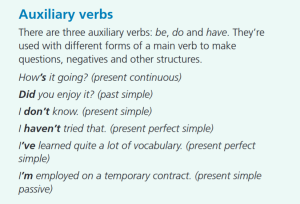
There are three auxiliary verbs: be, do and have. They are used with different forms of a main verb to make questions, negatives and other structures.
Be
We use forms of the verb be (am / is / are / was / were) with the -ing form of the main verb to form the present continuous and the past continuous. Note that we add not or -n’t to the auxiliary verb am / is / are / was / were to form the negative.
She isn’t feeling very well. (present continuous)
What are you studying? (present continuous)
They weren’t living in Porto at the time. (past continuous)
What was she doing in Kazakhstan? (past continuous)
We also use the verb be with the past participle to make passive forms of the verb.
What language is that written in? (present simple passive)
The film was made about ten years ago. (past simple passive)
Do
We use forms of the verb do (do / does / did) with the infinitive (without to) of the main verb to form negatives and questions in the present simple and past simple. Note that we add not or -n’t to the auxiliary verb do / does / did to form the negative.
He doesn’t really like this kind of music. (present simple)
We don’t live near each other. (present simple)
Do you like Indian food? (present simple)
I didn’t go anywhere last night. (past simple)
Did you have a good time last night? (past simple)
Have
We use forms of the verb have with the past participle form of the main verb to form the present perfect simple. Note that we add not or -n’t to the auxiliary verb have / has to form the negative.
Have you ever eaten snake?
Has your brother been to Lisbon before?
I’ve been there a few times.
She hasn’t arrived yet.
To form the present perfect continuous, we use have / has + been.
How long have you been studying English?
He hasn’t been working there very long.
We also use had to form the past perfect.
I didn’t see them. They had already left when I arrived.
We hadn’t met before. Yesterday was the first time.
7 Work in pairs. Read the questions from the conversations in Exercise 5 and answer questions 1–4.
a Do you know it?
b Did you enjoy it?
c Have you studied here before?
d Where are you based?
e What are you doing there? Are you working?
f How long have you been learning Spanish?
1 Which auxiliary goes with the infinitive form of the verb?
2 Which auxiliary goes with the -ing form of the verb?
3 Which two auxiliaries go with a past participle (often an -ed form) of the verb?
4 Which two auxiliaries can be used together?
8 Complete the questions with the correct form of be, do or have. Ask and answer the questions in Exercise 8.
1 Where ____ you live?
2 Who ____ you live with?
3 How long have you ____ living there?
4 Where ____ you born?
5 How long ____ it usually take you to get to work / school?
6 What ____ you do last weekend? Anything interesting?
7 Why ____ you studying at this school?
8 ____ you ever been to an English-speaking country?
9 ____ anyone else in your family speak English?
10 ____ anyone you know ever lived abroad? Where?