Listening. Study buddies

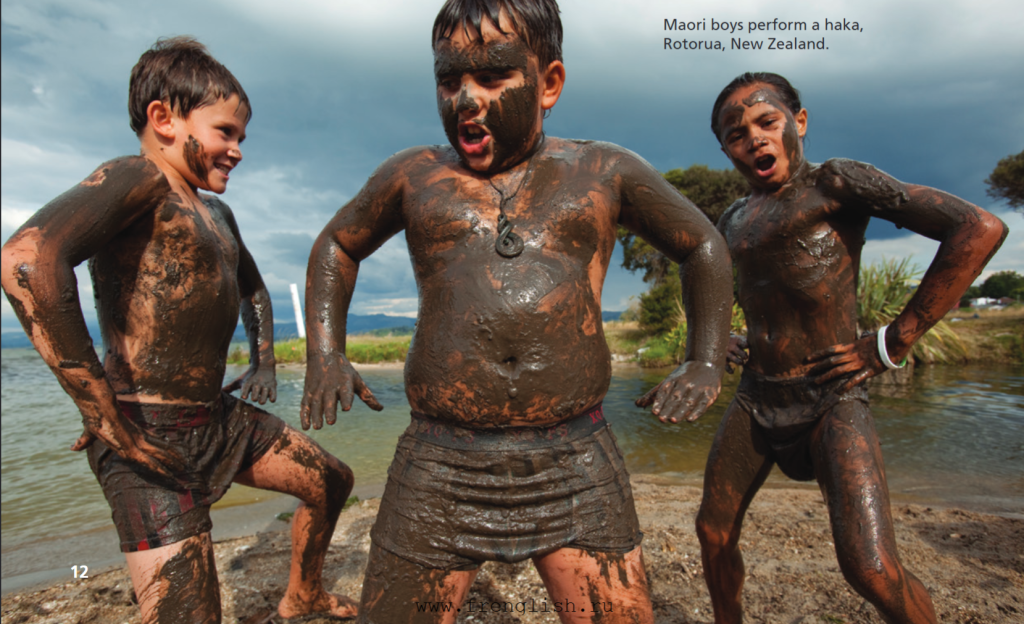
1 Work in pairs. Discuss the questions.
1 Look at the photo. What do you know about the Maori people and their culture?
2 What did you learn at school about traditional culture in your country?
3 Which parts of traditional culture are most / least interesting for you? Why?
4 Do you think schools should teach a country’s traditional languages? Why? / Why not?
1 Which speaker doesn’t talk about studying a language?
2 Which languages are the other speakers studying?
2 Listen to four short extracts. Answer the questions.
1 Which speaker doesn’t talk about studying a language?
2 Which languages are the other speakers studying?
Speaker 1
My business partner is Ma¯ori and so I’ve tried to learn Te Reo Ma¯ori a few times over the years – without much success. I’ve picked up a few words here and there, of course – things like ‘kia ora’ meaning ‘hello’ and so on – but it’s only these last few months that I’ve really had time to improve.
I’m taking classes twice a week and I’m not there yet, but I’m getting more fluent. I can feel it. The language is an important part of the culture and identity of New Zealand and though most people in my class are Ma¯ori themselves, interest in the language is really growing. You'll often hear it in advertising and in music on the radio now, for example.
Speaker 2
A: That was great. I really enjoyed that.
B: Me too. I think Marie is maybe the best French teacher I’ve ever had.
A: Hey, listen. I was wondering. Do you want to maybe meet sometime and practise a little bit?
B: Um. Well . . . maybe, I guess. It depends.
A: How about tomorrow?
B: Oh, I can’t I’m afraid. I’m working all day tomorrow. I don’t finish until nine.
A: So, how about Saturday? Are you working then as well?
B: Um … I’m not, no, but I’m meeting someone, I’m afraid. Sorry.
A: Oh, OK. Well, let me know if you ever have a bit of free time, anyway.
Speaker 3
I’m Brazilian, so I speak Portuguese, but I actually speak German at home. People are surprised when they find that out, especially because my parents are from Russia and Turkey! They first met when they were both working on a cruise ship. He worked in the engine room and she was a cleaner.
There was a kind of party every week and they met there. My mum said Dad was a really good dancer, which I find hard to believe. Anyway, neither spoke the other’s language, but my mum had worked in Germany and Dad knew German from school, so that’s how they communicated. They chose to settle in Rio because the cruises usually stopped here and they often had short holidays here. It also stopped them arguing about whose country to live in.
Speaker 4
It’s not easy, that’s for sure. The thing I find the hardest is remembering all the new vocabulary. What I usually do is record myself saying new words and phrases in my own language first and then in English. I listen and stop after I hear the
words in French, then try to say them in English and then play the recording and check. So for instance, I might hear ‘un fort accent’ . . . and stop the recording, try to remember the translation, and then say ‘a strong accent’. Like that. And I’m getting better. I understand more when I read and listen and the recordings help me see my progress too.
3 Linking words like and and but are often unstressed in fast speech. Listen to eight phrases.
4 Write down which of the phrases contain ‘and’ and which contain ‘but’? Then repeat the phrases one by one
Pronunciation notes
5 Listen to the four extracts again. Choose the correct option (a–c) to answer the questions.
6 Work in pairs. Discuss the questions.
1 Do you know any families which speak more than one language? Why?
2 Where and when do you use English outside the classroom?
3 Have you ever practised English with your classmates outside of class?
4 Have you ever translated for people outside of class? If yes, when?