Grammar. Present Simple and Present Continuous
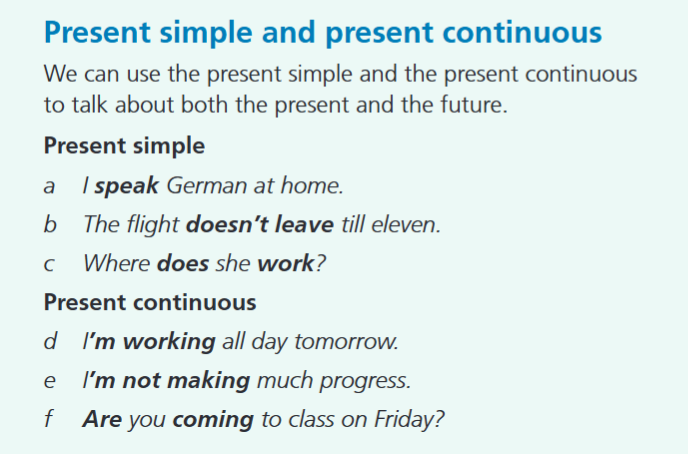
Present simple
We use the present simple to talk about both the present and the future. The main uses are to talk about:
1) habits and regular repeated activities. Note that we can say ‘how often’ using adverbs such as usually, often, sometimes, hardly ever and never.
I train on Saturdays.
I don’t usually play football on Wednesdays.
Does he always cycle to work?
2) facts and things that we see as permanent.
I live in Bucharest.
He doesn’t speak any other languages.
Does she work in the city centre?
3) future events that are part of a timetable or a schedule.
The bus leaves at 2:10.
My classes finish at 5:30.
Present continuous
We use the present continuous to talk about both the present and the future. The main uses are to talk about:
1) temporary, unfinished activities that are in progress at the time of speaking. Note that to emphasize that something is temporary, we often use expressions such as at the moment, currently, this week and this month.
She’s staying with her brother this week.
I’m not working at the moment.
Is it raining again out there?
2) things in the future that are already decided and planned or agreed / arranged with other people.
I’m going out for dinner with a client on Friday.
We’re getting married in the summer.
They aren’t meeting tomorrow.
Stative verbs
Verbs which express states (such as attitude, feelings or possession) are generally used in the simple form, even to describe unfinished or temporary states. These verbs include:
— agree, believe, belong, depend. disagree
— doubt, forget, hate, know, like, matter, mind, owe, own, prefer
— realize, seem, suppose, taste, want.
Are you OK? You seem a bit sad.
I don’t want to talk about it at the moment.
I’m tired. I need to go to bed.
Note that we can use some of these verbs in the continuous form. This is usually when we want to emphasize that the feeling or situation is temporary.
I’m really liking this risotto. It’s delicious.
Are you wanting anything more to eat?
7 Work in pairs. Look at the examples in the Grammar box. Answer the questions.

1 Which two examples are about habits / regular, repeated activities?
2 Which example is about a future timetable?
3 Which example is about a temporary, unfinished activity?
4 Which two examples are about things in the future that are already decided and planned / arranged with other
people?
5 What is the connection between the verbs in the box?
8 Complete the conversations with the present simple or present continuous form of the words in brackets.
9 Write reasons to explain why you can’t or don’t want to do the things (1–5). Use the present simple or present continuous.