Reading
2. Listen and read the extract from a wiki entry explaining urban legends. Then with a partner discuss how far it matches your ideas in Exercise 1. Did you find any new information?
Urban Legends
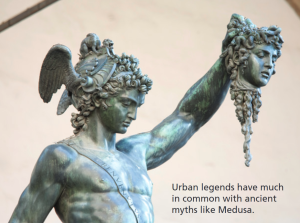 ‘Urban legend’ is a term popularized by Professor Jan Brunvand in collections such as The Choking Doberman and Other ‘New’ Urban Legends. Brunvand taught folklore studies, a subject which encompasses a wide range of traditions and culture typically passed on from generation to generation by word of mouth or by imitation rather than the written word. One area of folklore is fairy tales and myths, such as those collected by the Brothers Grimm in the early 19th century, which typically involve magic or monsters and carry a moral. In his early days at Utah University, Brunvand found that students saw folklore as fundamentally old and not something that was part and parcel of modern life. Partly to counteract this attitude, he introduced his students to the idea of the urban legend.
Brunvand argued there were many stories that circulate in our own society and function in much the same way as fairy tales. He started collecting these urban legends and asked his students to contribute stories they heard or saw reported in the media.
Similarities with myths and fairy tales
Listeners might not immediately recognize urban legends as essentially modern fairy tales because they are typically introduced as happening to ‘a friend of a friend’ rather than set ‘Once upon a time’. Other realistic details are added by the teller, such as setting the events in a real city, using common names or reporting specific dialogue. However, while these additions vary from place to place, the core plot remains the same everywhere and as these same stories are told so far and wide, they are clearly as fictional as any fairy tale.
Similarly, the modern-life contexts of most urban legends – crime, office work, sewage systems, suburban homes – may give an air of authenticity but, on closer examination, the stories actually share many unreal features of older legends: magic, monsters, violence and horror. For example, the ‘magic’ may be the mystery of someone returning a ‘lost’ item only to find the owner has been dead for some time; the monster may be a spider living in a woman’s hairdo; the violence and horror could be a burglar being maimed by a dog, or a boyfriend coming to a grisly end after he abandons his partner.
And just as stories such as Medusa or Hansel and Gretel may have reflected those societies’ misogynistic attitudes or fear of famine, Brunvand suggested urban legends may reveal something about the darker side of city life and what we are afraid of in contemporary society.
Differences to rumour and conspiracy
Urban myths have much in common with rumours, conspiracy theories or fake news, and the boundaries between them are not cut and dried. They are all fictions that get retold orally or through social media but, by and large, rumours and conspiracy theories arise in response to particular events which we feel threatened by. For example, a rumour could ‘explain’ why a building has collapsed or what might replace it. Rumours are often pieces of information, whereas urban myths are first and foremost ‘horror’ or entertainment stories with a beginning, middle and end.
Urban Legend examples
The babysitter: a babysitter gets phone calls time and again telling them to check the kids who are sleeping upstairs. The babysitter phones the police who trace the next call to the same house the babysitter is in.
Cockroach eggs in drinking straws: someone in a fast food restaurant notices their coke tastes off and finds lots of tiny specks. Subsequent research reveals an epidemic of cockroach eggs in fast food straw dispensers throughout the city.
The jogger’s wallet: a man chases down a mugger and reclaims his wallet … only to find his own wallet is actually at home.
Alligators in the sewers: wild animals – usually gators, but also wild pigs! – are discovered by labourers doing work on the city sewer.
3. Work in pairs. Read the extract again and decide if the following statements are true (T), false (F) or not given (NG) according to the information in the extract.
4. Make a list of six words or phrases from the text that were new for you and that you think might be useful to remember.
5. Work in groups. Compare your lists and agree on the most useful six words or phrases.
6 Work in pairs. Read and discuss sets of questions.
1 Do you think folklore is a good thing to study and research? Why? / Why not? What tradition or story would you pass on to the next generation?
2 Have you heard any variations of the urban myths mentioned in the text? What moral do they teach or what aspects of modern life do they reflect?
3 Are there any derelict buildings where you live? Who owns them? What’s going to happen to them? Are there any stories about them?
4 Do you think rumour, conspiracy and fake news are increasing? Why? Are there any particular rumours circulating at the moment?